



JiaXing Sunrise Import&Export Co.,Ltd has come a long way since its inception. In 2011, the company established its factory in Jiashan, China, to ensure strict quality control and production procedures. This step marked a turning point in the company's history and laid the foundation for its growth and development. The company's focus on customer satisfaction and long-term relationships has helped it to earn the trust of customers both domestically and internationally.
Why Choose Us
Professional team
Our professional team collaborate and communicate effectively with one another, and are committed to delivering high-quality results. They are capable of handling complex challenges and projects that require their specialized expertise and experience.
Advanced equipment
A machine, tool or instrument designed with advanced technology and functionality to perform highly specific tasks with greater precision, efficiency and reliability.
Quality control
We have professional personnel to monitor the production process, inspect the products and ensure that the final product meets the required quality level standards, guidelines and specifications.
24H online service
We respond to all questions within 24 hours and if any emergencies arise, our team is always at your service.
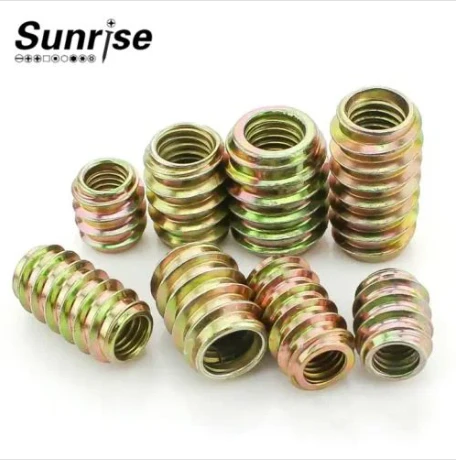
Internal And External Thread Nuts
Internal threads refer to those on nuts and tapped holes, while external threads are those on bolts, studs, or screws. The thread form is the configuration of the thread in an axial plane; or more simply, it is the profile of the thread, composed of the crest, root, and flanks.
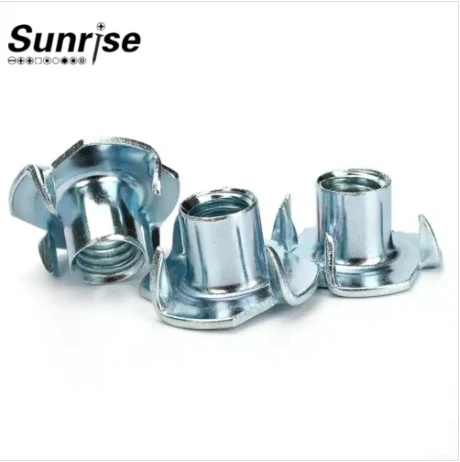
Hopper feed tee nuts offer high retention and reliable entry to reduce labor and rework costs. Possible substitute for 4 prong T-Nut. These tee nuts are incredibly durable and wear- and tear-resistant because they are made of high-quality materials like stainless steel and nylon. They have a special hopper feed feature that makes installation in remote areas simple.

A T-shaped profile is produced by the threaded inner section and flanged edge of half thread tee nuts, a type of fastener. These nuts are made of high-quality materials and are intended to connect two parts in a trustworthy and long-lasting way.

Essential fasteners used in many applications to securely join two pieces of material are full thread nut nuts. These nuts are made from high-quality materials and are perfect for construction, DIY projects, and industrial use because they offer a strong and long-lasting connection.
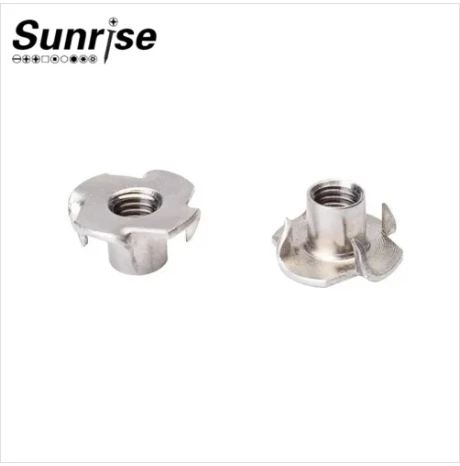
Stainless Steel Tee Nut With 4 Claw
Stainless steel tee nut with 4 claw are alternatively referred to as stainless T nuts, GRIFF nuts, claw nuts or four pronged nuts for wood. This flat base features four evenly spaced prongs which grip into both hard and soft wood, or plastic once fastened. This acts as an anchor, locking the nut in place and preventing movement during assembly.
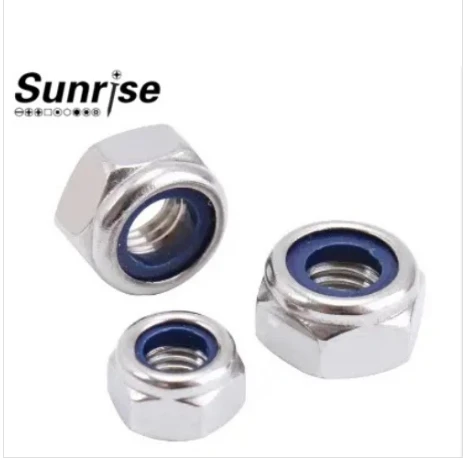
A Nylon lock nut Din 985 also known as a lock nut, locking nut, prevailing torque nut, stiff nut or elastic stop nut. It is a nut that resists loosening under vibrations and torque. Elastic stop nuts and torque nuts are of the particular type.

DIN 1587 Hex Dome Nut Spherical Nut
Hex dome nut and sphere nuts, or DIN 1587, are a widely used fastening component in many different industrial applications. This nut has a distinctive dome-like top and spherical shape that provides excellent protection and improved aesthetic appeal.

Hot Dipped Galvanized Carbon Steel Hex Nut Grade 4.8 Grade 8.8
The nut is shielded from rust and corrosion thanks to the hot-dip galvanizing process. Six sides make up the hex nut, and when tightened, they offer a secure grip. It is perfect for use in a variety of industries, including the construction, automotive, and HVAC sectors, thanks to this feature. The nut is suitable for heavy-duty tasks due to its strength and durability.

Flange Hex DIN6923 Yellow Zinc Plated
The screw or bolt's pressure is evenly distributed and Wo n't slip thanks to its combination of a hexagonal head and flanged washer. For applications requiring high torque, the flange is perfect because it offers a larger bearing surface for load distribution. Zinc plated and yellow zinc Plated finishes provide corrosion resistance without sacrificing strength.
What is Internal And External Thread Nuts
For a variety of applications, our Internal and External Thread Nuts are an excellent fastening solution. These nuts offer exceptional strength, durability, and dependability because they are made from high-grade materials. Internal threads refer to those on nuts and tapped holes, while external threads are those on bolts, studs, or screws. The thread form is the configuration of the thread in an axial plane; or more simply, it is the profile of the thread, composed of the crest, root, and flanks.
Advantages of Internal And External Thread Nuts
Strong durability
The internal thread nuts are fixed in the holes, so they are not easy to loosen or fall off. This fastening method is more stable than other methods, so internal thread nuts are more durable than other fasteners.
Beautiful and tidy
Internal thread nuts can be installed inside the plate or other surface, so they will not affect the appearance or aesthetics. This method of fastening is more aesthetically pleasing and tidier than other methods.
Stronger holding power
Due to the large coverage area of the internal thread nuts, the internal thread nuts connection can connect the two components more closely and have stronger holding power. It is easier to install and adjust than other fasteners.
Ease of installation
External thread nuts are typically easier to install compared to internal nuts since they are accessible from the outside of the assembly. External thread nuts allow for easy adjustment of tension or torque by simply turning the nut, making them ideal for applications where frequent adjustments are required.
Visual inspection
External thread nuts offer visual confirmation of proper fastening, allowing for quick inspection and maintenance checks without disassembly. External thread nuts come in various shapes, sizes, and designs, making them versatile for use in a wide range of applications and industries.
Sturdy structure
During the connection process, the external thread nuts can provide very high contact force due to its own locking effect, thereby ensuring close contact and stability between connected parts, and effectively preventing connected parts from loosening or falling off even in vibration and shock environments.
Internal and external threads differ in their location and function. Internal threads are located inside a hole or recess and are designed to mate with external threads. External threads, on the other hand, are located on the outside of a cylindrical object and are designed to mate with internal threads. They are commonly found on bolts, screws, and other fasteners. Internal threads are typically used for creating a fastening connection, while external threads are used for creating a tight, secure connection when mated with internal threads. Both types of threads are essential in various mechanical and structural applications, and their precise design and compatibility are crucial for ensuring proper assembly and functionality.
When selecting internal and external thread nuts, various factors such as the stress state, load conditions and usage environment of the workpiece, as well as the production and processing technology, should be comprehensively considered. It cannot be simply assumed that the strength of external threads must be better than that of internal threads. It should be noted that for important connections, high-strength threads are usually required to ensure the safe operation of the workpiece. At the same time, in order to improve the reliability of threaded connections, appropriate coatings (such as anti-rust oil, special coatings, etc.) and methods of controlling tightening force (such as hydraulic wrenches, torque wrenches, etc.) should also be used. All these measures help to increase the service life of the threads and reduce maintenance costs and risks.

Does a Nut Have an Internal Thread?
Bolts are threaded fasteners with external male threads. They mate with nuts, which have female meaning, internal threads. Both the bolt and the nut grip the materials being fastened, creating a bolt joint, with the nut also preventing axial movement.

Taps and dies are metal threading tools used to cut and restore internal and external threads precisely. A tap is used to form the female component of the assembly, as in the case of a nut or socket, a die is used on the male component, as in a screw or bolt.
A nut is a nut, a part that is screwed together with a bolt or screw for tightening. It is a component that all manufacturing machinery must use. According to different materials, it is divided into carbon steel, stainless steel, non-ferrous metals (such as copper), etc. Several major types.
Dies are used to make external threads on a rod, creating a threaded surface that allows a bolt to be fastened to it. The die is applied to a specific diameter of rod for the size and pitch of the threads you want to cut. An external thread (screw thread), is cut by hand with a round die that is fixed in a die stock.
Application of Internal And External Thread Nuts
Application of internal thread nuts
Internal threads nuts are widely used in various types of mechanical equipment, such as brakes for automobiles and motorcycles, machine tool connectors, and water pipe joints. Parts with internal thread structure can be used in conjunction with parts with external thread structure to achieve mechanical connection.
Application of external thread nuts
External threads nuts are widely used in fasteners such as nails, bolts, and nuts, as well as automotive tires, hydraulic pipe joints, valves, and more. Parts with external thread structure can be used in conjunction with parts with internal thread structure to achieve mechanical connection.
Components of Internal And External Thread Nuts
Internal threads refer to those on nuts and tapped holes, while external threads are those on bolts, studs, or screws. The thread form is the configuration of the thread in an axial plane; or more simply, it is the profile of the thread, composed of the crest, root, and flanks.
Lubrication: Lubricate nuts and threads before assembly and disassembly to prevent bolt corrosion and breakage.
Use an air pressure cleaner: Always clean the thread grooves before inserting stainless steel fasteners. Debris can affect its tightening.
Use an anti-seize compound: Use an anti-seize compound on the nuts or threads - this is especially helpful if you work at high temperatures.
Always use the correct equipment: Use the correct equipment, such as a wrench, to tighten nuts and threads to prevent damage.
See owner's manual
Read the manual to learn the specific tightening torque technique for your fastener, as each technique will vary based on thread and material.
Use washers
Washers aid in the tightening process and prevent nuts and threads from loosening.
Use locking nuts
Locking nuts help prevent loosening and friction by firmly gripping the nut or threads.
Different internal and external threaded nuts should be selected according to different working environments and pressures. If the pressure is too great, you need to choose a high-strength nut, otherwise it will cause serious deformation or damage to the nut. The internal and external threaded nuts must be tightened firmly, and attention must be paid during the tightening process to avoid being too tight or too loose. If it is too tight, it will cause deformation of the threaded parts, and if it is too loose, it will affect the firmness of the fixation. The fixing threads of internal and external threaded nuts are different. When installing, you need to choose the correct combination according to the situation and pay attention to the direction, and cannot be changed at will. Pay attention to the tolerances of internal and external threaded nuts to avoid inappropriate gaps or over-tightening problems.
What Tools are Used to Create Both Internal and External Threads?
The thread milling cutter can mill an internal and external thread and can also be used on thin-walled workpieces. It is possible to produce the bore and thread in one working process. The thread milling cutter can be used on almost all materials.
Our Factory
JiaXing Sunrise Import&Export Co,Ltd is a fastener supplier with a factory located in Jiashan, China. Our factory covers an area of over 10,000 square meters and is equipped with advanced machinery and equipment, enabling us to produce a wide range of high-quality fasteners. Our factory employs a team of experienced and skilled workers who are committed to producing only the best products.

FAQ
Hot Tags: internal and external thread nuts, China internal and external thread nuts manufacturers, suppliers, factory, Thumb Screws, Combination Tooth Lock Washer, Flat Metal Washers, Square Washer, DIN9021 Washer, Flat Washer For Pin Shaft