



Products Description
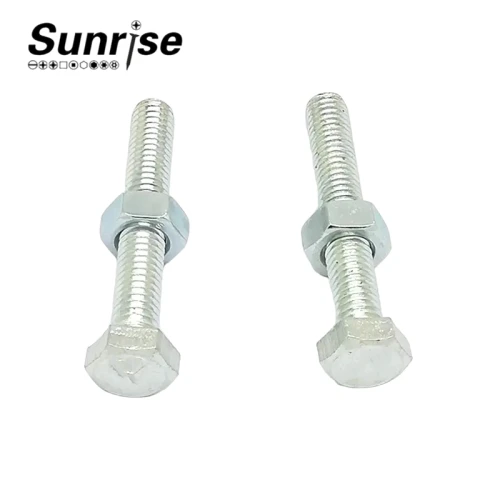
Full Thread Fastener Stud Bolt and Nut are high-performance fasteners designed for securing components in a wide range of mechanical, structural, and industrial applications. The stud bolts feature fully threaded shafts, allowing for greater flexibility in length adjustment, while the accompanying nuts provide secure fastening. These fasteners are typically used in applications where precise tensioning or adjustable lengths are required. Constructed from durable materials, including stainless steel, carbon steel, and alloy steel, the stud bolts and nuts provide excellent strength, reliability, and resistance to corrosion, making them suitable for use in demanding environments.
Key Parameters:
Material: Stainless Steel (304, 316), Carbon Steel, Alloy Steel
Thread Type: Full Thread
Sizes: M6 to M100 (custom sizes available)
Length Range: 30mm to 500mm (custom lengths available)
Strength Grade: 8.8, 10.9, 12.9 (depending on customer specifications)
Surface Finish: Zinc Plated, Galvanized, Passivated, Black Oxide, or Natural Stainless Steel
Compliance: ISO 898-1, DIN 975, ASME B18.31.2
Certifications: ISO 9001:2015, RoHS Compliant, CE Marked
Products Process
Material Selection:
The manufacturing process begins with the selection of high-quality materials, including stainless steel (304, 316), carbon steel, or alloy steel. The choice of material depends on the specific application, taking into consideration factors such as corrosion resistance, tensile strength, and environmental exposure.
Cold Heading:
Stud bolts are produced by cold heading, where wire is fed into a machine and shaped into the desired dimensions. This process helps to form the stud bolt's body while maintaining its strength and dimensional accuracy.
Thread Rolling:
After the stud bolt is formed, the threads are rolled onto the shaft. This method produces stronger and more durable threads compared to cutting, ensuring a smooth finish and resistance to wear and corrosion.
Nut Production:
The nuts are typically manufactured through a combination of cold forming and machining. Cold forming is used for the initial shaping, and the final dimensions and threads are refined through precise machining.
Heat Treatment (Optional):
Depending on the material and desired properties, heat treatment may be applied to enhance the mechanical properties, such as increasing hardness or improving tensile strength. This is especially important for high-strength applications.
Surface Treatment:
After the studs and nuts are produced, they undergo surface treatments like passivation, zinc plating, or galvanizing to enhance corrosion resistance. This ensures the fasteners can withstand exposure to moisture, chemicals, and other harsh environments.
Quality Control:
Every batch of stud bolts and nuts undergoes rigorous testing for dimensional accuracy, tensile strength, and threading quality. This includes checks for hardness, load-bearing capacity, and resistance to corrosion.
Products Application
Full Thread Fastener Stud Bolts and Nuts are versatile and widely used in various industries due to their strong mechanical properties, durability, and corrosion resistance:
Construction & Civil Engineering: Used for securing structural elements such as beams, columns, and frames, ensuring the integrity of building foundations and infrastructure.
Automotive & Aerospace: Used in the assembly of vehicle components, engine parts, and machinery that require robust and adjustable fasteners.
Oil & Gas Industry: Commonly used in pipe flanges, valves, and equipment where high-strength, corrosion-resistant fasteners are necessary for safety and reliability in challenging environments.
Marine & Offshore: Ideal for use in marine environments, offering high resistance to saltwater corrosion in ships, offshore platforms, and coastal infrastructure.
Power Plants & Energy: Essential in wind turbines, solar panel installations, and other renewable energy projects, ensuring the secure assembly of critical infrastructure.
Heavy Machinery & Industrial Equipment: Used in machinery, turbines, and industrial equipment where strong, durable, and reliable fasteners are essential.
FAQ
What materials are available for Full Thread Fastener Stud Bolts and Nuts?
Full thread fastener stud bolts and nuts are available in various materials, including stainless steel (304, 316), carbon steel, and alloy steel. The material selection depends on the application and environmental conditions.
What is the advantage of a full-thread design?
The full-thread design provides more flexibility in adjusting the length of the bolt or stud, allowing for secure fastening across a range of applications. It ensures even distribution of pressure along the entire length, making it ideal for tensioning applications.
Can I use these fasteners outdoors or in corrosive environments?
Yes, stud bolts and nuts made from stainless steel (especially grades 316) offer excellent corrosion resistance, making them suitable for outdoor and marine environments, as well as chemical or food processing industries.
What sizes do these fasteners come in?
Full thread stud bolts and nuts come in sizes ranging from M6 to M100, with lengths ranging from 30mm to 500mm. Custom sizes can be produced based on specific requirements.
Are these fasteners suitable for high-temperature applications?
Yes, stud bolts and nuts made from high-quality stainless steel or alloy steel are suitable for use in high-temperature applications. However, it's important to choose the right material grade for the temperature range and mechanical stress involved.
What is the difference between stud bolts and regular bolts?
The primary difference is that stud bolts have threads along their entire length, while regular bolts may have only a partial thread. This makes stud bolts more versatile and suitable for applications where adjustable length and high tensile strength are required.
How do I ensure the proper torque when installing these fasteners?
Proper torque should be applied according to the specifications of the stud bolt and nut. This is typically done with a calibrated torque wrench. It's important to follow recommended torque values to avoid damaging the threads or over-stressing the materials.
Are these fasteners certified for quality?
Yes, Full Thread Fastener Stud Bolts and Nuts are manufactured in accordance with international standards such as ISO 9001:2015 for quality management. They are also RoHS compliant and CE marked to meet safety and environmental standards.
What surface finishes are available?
These fasteners are available with various surface finishes, including zinc plating, galvanization, passivation, and black oxide. The surface finish is chosen based on the application environment and corrosion resistance requirements.
Can I use these fasteners in the oil and gas industry?
Yes, these fasteners are ideal for use in the oil and gas industry due to their strength, corrosion resistance, and ability to withstand high pressures and harsh environmental conditions.
Hot Tags: full thread fastener stud bolt and nut, China full thread fastener stud bolt and nut manufacturers, suppliers, factory, ANSI ASME B18 21 1 Spring Lock Washer, Special Rivets, Self locking Nut, Sheet Metal Tapping Screws, Hardware Fittings, Plastic Tapping Screws