



Products Description
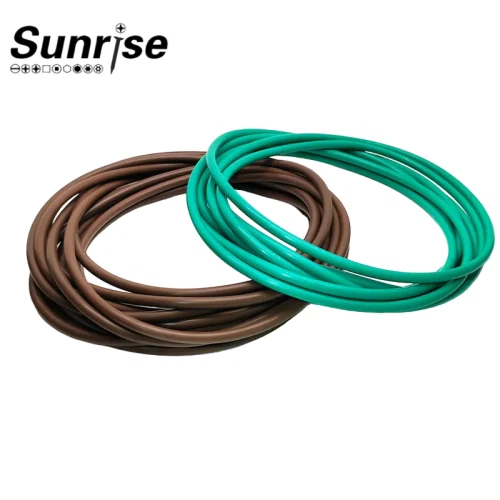
O-Ring seals are available in a variety of sizes and hardnesses, ranging from 60 to 90 Shore A, making them reliable sealing options for a variety of applications. These seals are created with high-quality materials to ensure performance, flexibility, and durability in a variety of settings. With the ability to create custom sealing solutions that can handle varying pressure and temperature levels effectively.
Key Parameters:
Material Options:
Nitrile (NBR), Viton (FKM), Silicone (VMQ), EPDM, and other elastomers upon request.
Hardness Range:
60 to 90 Shore A, customizable based on application requirements.
Temperature Range:
Nitrile (NBR): -40°C to 120°C (-40°F to 248°F)
Viton (FKM): -20°C to 200°C (-4°F to 392°F)
Silicone (VMQ): -60°C to 250°C (-76°F to 482°F)
EPDM: -40°C to 150°C (-40°F to 302°F)
Chemical Resistance:
Nitrile (NBR): Good resistance to oils and fuels.
Viton (FKM): Excellent resistance to chemicals and high temperatures.
Silicone (VMQ): Excellent resistance to high temperatures and weathering.
EPDM: Good resistance to water and steam.
Size Range: Custom sizes available upon request. Standard sizes include various diameters and cross-sections.
Color: Typically black, but other colors can be produced based on customer requirements.
Products Process
Material selection
Rubber Types: Depending on the application's requirements, high-performance elastomers like those used in nitrile( NBR), viton( FKM), silicon (VMQ), and EPDM are chosen.
Hardness Range: Available materials range in the range of 60 to 90 Shore A for specific sealing requirements.
Compounding:
To achieve the desired hardness, flexibility, and chemical resistance, rubber compounds are combined with additives. All ingredients are evenly distributed during the mixing process.
Molding:
The O-Ring seals are created by combining rubber that has been specially engineered to form them. Every O-Ring is made using the molding process to achieve the correct hardness and dimensions.
Vulcanization:
A vulcanization process is used to heat treatment the molded O-Rings. This process strengthens the O-Rings 'elasticity and strength by strengthening the rubber molecules.
Quality Control:
To ensure compliance with industry standards and specifications, each O-Ring goes through rigorous testing, including hardness testing, dimensional testing, and performance assessments in various circumstances.
Products Application
Automotive Industry: Sealing of hydraulic, fuel, and other crucial components.
Aerospace: Used in aircraft components that demand a high level of extreme durability and resistance.
Industrial Equipment: Industrial equipment includes seals for machinery, valves, and pumps that operate at varying temperatures and pressures.
Pharmaceutical and Food Processing: Processing for pharmaceuticals and food products: suitable for applications that demand cleanliness and hygiene.
Construction: Used in heavy equipment and machinery where it is crucial to protect against chemicals, dust, and water.
FAQ
1. What degree of hardness are these O-Rings '?
Our O-Rings are available in a range of hardness levels, ranging from 60 to 90 Shore A, giving you the freedom to choose the best hardness for your application.
2. What materials are used to create the O-Rings?
O-Rings made of various materials are available from us, including EPDM, silicone, and nitrile( NBR), and viton( FKM). The material you choose will depend on your application's specific requirements.
3. What is the temperature range for these O-Rings?
The temperature range varies depending on the material:
Nitrile (NBR): -40°C to 120°C (-40°F to 248°F)
Viton (FKM): -20°C to 200°C (-4°F to 392°F)
Silicone (VMQ): -60°C to 250°C (-76°F to 482°F)
EPDM: -40°C to 150°C (-40°F to 302°F)
4. Can you make these O-Rings custom-sized to your liking?
Yes, we can make O-Rings custom sizes. For a custom quote, please provide the necessary dimensions or specifications.
5. What factors should be taken into account when choosing the O-Ring's hardness?
The application's pressure, temperature, and chemical exposure should be considered when choosing the O-Ring's hardness. When flexibility and conformability are required, softer O-Rings are typically used for high-pressure applications.
6. What is the proper storage for these O-rings?
To maintain their properties and extend their usefulness, keep O-Rings in cool, dry conditions away from direct sunlight and extreme temperatures. Avoid contact with ozone and other substances that could damage rubber.
7. Exist any special handling instructions?
To prevent deformation or harm, handle O-Rings carefully. Make sure the O-Ring is properly positioned in its groove to prevent leaks and ensure optimal performance when installing it.
Hot Tags: Various sizes of O-ring seals with hardness 60-90, China Various sizes of O-ring seals with hardness 60-90 manufacturers, suppliers, factory, Wing Nut, Sheet Metal Tapping Screws, Chamfered Washer, Square Washer, Nylon Lock Nut, Wing Screws