


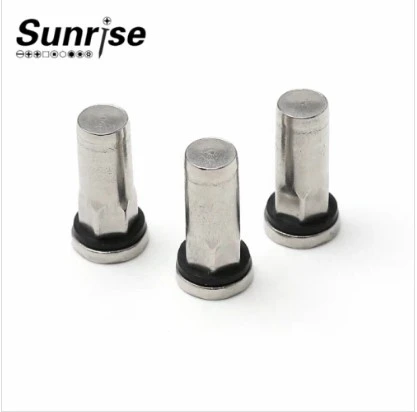
JiaXing Sunrise Import&Export Co.,Ltd has come a long way since its inception. In 2011, the company established its factory in Jiashan, China, to ensure strict quality control and production procedures. This step marked a turning point in the company's history and laid the foundation for its growth and development. The company's focus on customer satisfaction and long-term relationships has helped it to earn the trust of customers both domestically and internationally.
Why Choose Us
Professional team
Our professional team collaborate and communicate effectively with one another, and are committed to delivering high-quality results. They are capable of handling complex challenges and projects that require their specialized expertise and experience.
Advanced equipment
A machine, tool or instrument designed with advanced technology and functionality to perform highly specific tasks with greater precision, efficiency and reliability.
Quality control
We have professional personnel to monitor the production process, inspect the products and ensure that the final product meets the required quality level standards, guidelines and specifications.
24H online service
We respond to all questions within 24 hours and if any emergencies arise, our team is always at your service.
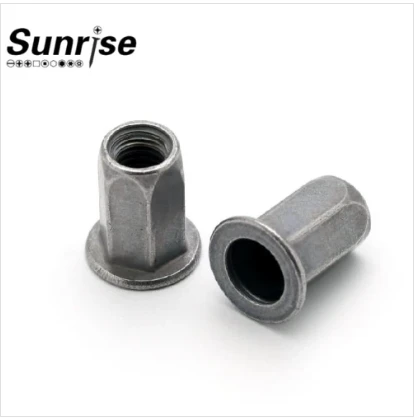
Full-Hexagon With Big Flange,Flat Head,Round Internal Hole,Open End Rivet Nut
A flexible and dependable fastening option is the full-hexagon with big flange, flat head, round internal hole, open end rivet nut, also known as the FHBM series. With a large flange, flat head, round internal hole, and an open end design, this rivet nut is fully hexagonal in shape. To suit various applications, it is offered in a variety of thread sizes, hole widths, grip lengths.
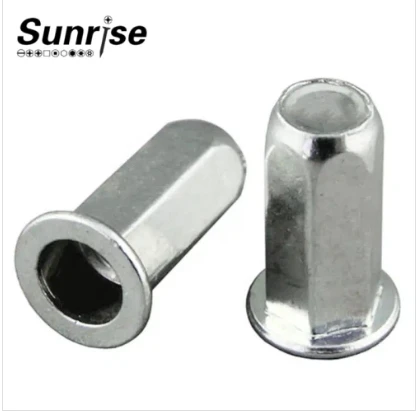
Stainless Steel Full Hex Body Flat Head Rivet Nut
A high-quality fastener with a flat head and hexagonal body design is the stainless steel full hex body flat head rivet nut. Because of its excellent corrosion resistance and durability, it is made of stainless steel. T he flush installation is made possible by the flat head design, giving the appearance of being finished and clean.
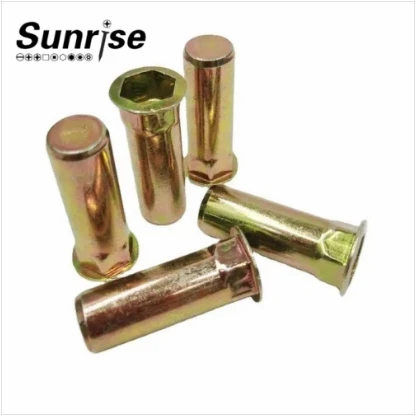
Flat Head Half Hex Body Rivet Nut
The flat head half hex body rivet nut is a thin-wall fastener. It is easily installed during assembly or during after-market use with a spin/spin tool. The specific fastener will be dependent on your host material thickness. The flat head half hex body rivet nut is made using steel with a zinc finish, stainless, or aluminum.
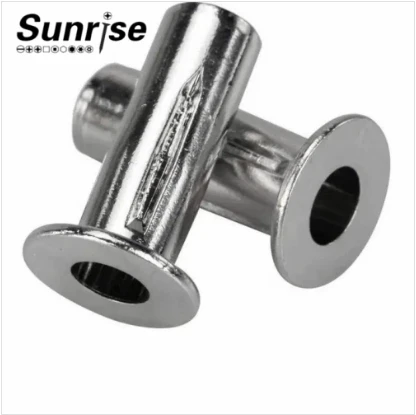
Pre-bulbed split rivet nut are a flexible fastening option used in many different industries. It is designed to provide a strong and secure threaded connection in low-resistance materials such as metal and non-metallic sheet materials. Due to their pre-thickened body and slotted design, rivet nuts have excellent pullout resistance and self-positioning capabilities.
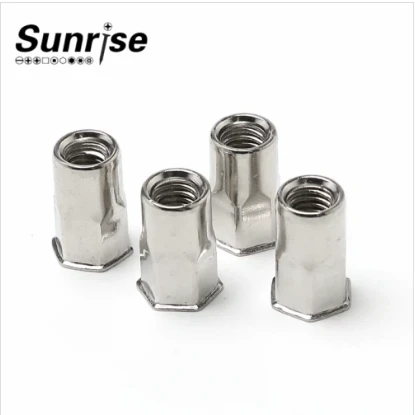
Cage Nuts Rivet Insert Nested Nut
Cage nuts consist of a nut in a spring steel cage which wraps around the nut. The cage has two wings that when compressed allow the cage to be inserted into the square holes, for example, in the mounting rails of equipment racks. When the wings are released, they hold the nut in position behind the hole.
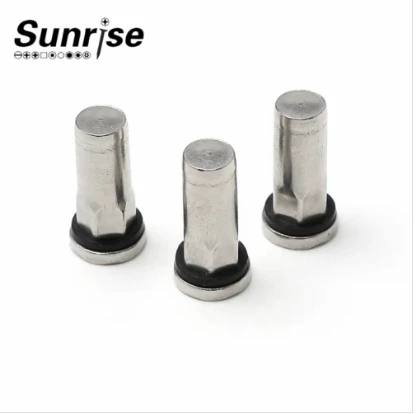
Self-clinching standoffs provide a solution when design engineers need to space panels and components in their metal enclosures. They are used to stack parts or keep components a defined distance from the panel in which they are installed.
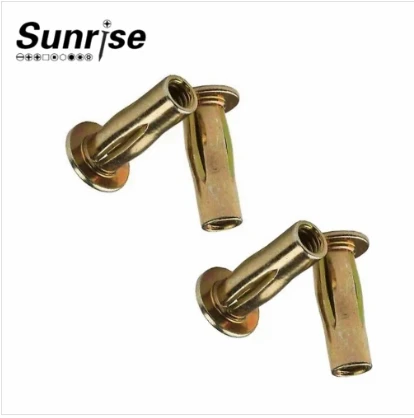
Plus cross insert rivet nut, sometimes called plus nuts or cross nuts, feature a round slotted body with a straight shank or pre bulbed shank for increased spin out resistance. This slotted series of rivet nut offers a large grip range that is ideal for single, variable, or multiple thickness materials.
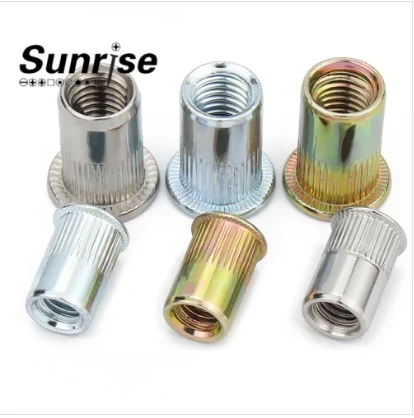
Rivet Nut Small Head With Knurl
The rivet nut small head with knurl a locking device to avoid the turning of the insert in the component. These blind rivet nuts are used preferably in components with lower regidity (component material is less "hard" than the material of the blind rivet nut).
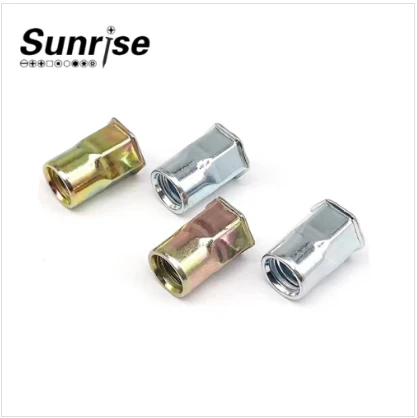
Half Hex Countersunk Head Rivet Nut
Countersunk half hex rivet nuts have a visible 90 degree countersunk and require a pre-drilled countersunk hole to enable them to fit flush; they are inserted into a hexagon hole which eliminates the potential problem of the nut turning in the hole after installation.
Self Clinching Standoff Nut are a type of fastener used to insert a load bearing thread into a sheet of material, often in order to raise it above another. They work in a similar way to rivet bushes, allowing greater loads to be fastened to relatively weak material. They are inserted into a pre-drilled hole, and are then squeezed to force the sheet material to flow into the grooves on the shaft, which secures it into place.
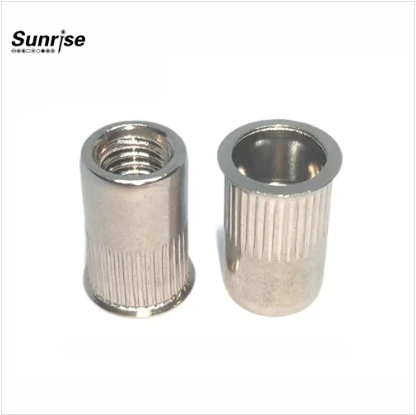
Self clinching standoff nut are usually made of high-strength steel, stainless steel, aluminum alloy and other materials. The choice of materials depends on the requirements of the specific application, such as corrosion resistance for the loads they will bear, weight requirements, etc. High-strength steel is usually used to bear larger loads. In this scenario, stainless steel materials are used in environments with high requirements for corrosion resistance, while aluminum alloys are often used in situations where lightweighting is required.
What is The Difference Between a Weld Nut and a Self Clinching Standoff Nut?
The production process is different. Self clinching standoff nuts require pre-drilling holes and riveting the nut into the shell, while welding nuts require welding operations.
The fastening effects are different. The tightening force of self clinching standoff nuts mainly depends on riveting technology, while the tightening effect of welding nuts depends on the welding quality.
The scope of application is different. Self clinching standoff nuts are suitable for fastening many materials such as plates and pipes, while welding nuts are more used in large-scale projects such as steel structures and bridges.
The degree of convenience of operation is different. Self clinching standoff nut require machine operation, while welding nuts require skilled welding workers.
In order to improve the corrosion resistance and surface quality of self clinching standoff nuts, it is often necessary to Perform surface treatment. Common surface treatment methods include electroplating, spraying, and anodizing Transformation, etc. Electroplating can use methods such as galvanizing, nickel plating, and chromium plating, while spraying can use methods such as Spraying, painting and other methods, while anodizing can increase the surface of aluminum alloy nut columns Hardness and corrosion resistance.
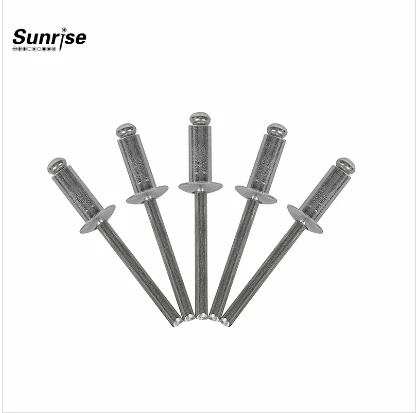
Application of Self Clinching Standoff Nut
Mechanical processing
In the machining industry, self clinching standoff nut have a very high application rate and can be used for the processing and assembly of many mechanical parts. Compared with traditional threaded parts, self clinching standoff nuts have excellent performance and reliable fixation, and will not cause problems such as loosening or falling off.
Sheet metal assemblies
These nuts are frequently employed in sheet metal assemblies, where they provide a strong and permanent threaded attachment point without the need for welding or additional hardware. This is useful in applications like automotive assemblies, HVAC systems, and appliance manufacturing.
Automobile manufacturing
In the automobile manufacturing industry, self clinching standoff nuts not only have the advantages of sealing and fixing, but can also improve the stiffness and safety of the automobile body and ensure the safety and stability of the automobile body.
Aerospace industry
In the aerospace industry, self clinching standoff nuts can be used to fix and install key components such as aircraft seats, structural parts, rims, landing gear, mechanical cabins, and fuel systems. Their fixing capabilities and reliability have been fully verified.
Electronic enclosures
Self clinching standoff nuts are widely used in electronic enclosures, such as computer cases, server racks, and control panels. They provide reliable mounting points for circuit boards, panels, and other electronic components.
Components of Self Clinching Standoff Nut
The self clinching standoff nut is a nut that can quickly fix threaded parts. Its structure mainly consists of a riveting head, a base, threads and a shell. Among them, the shell is the main part of the self clinching standoff nut , and its interior is a threaded structure used to fix the threaded parts that match it. The riveting head is located at the top of the shell and is used to press the rivet into the shell through the riveted part and the base to form a fixing effect, while the base is used to fix the nut in the application.
Correct Maintenance Techniques for Self Clinching Standoff Nut Posts
Check the status of the nut
First use a tool to remove the self clinching standoff nut, check its status and determine whether it needs to be replaced.
Clean the nut
Use detergent or other tools to clean the surface of the nut to remove corrosion and dirt.
Anti-corrosion treatment
Nuts that are prone to corrosion need to be anti-corrosion treatment to extend their service life.
Replace the nut
If you find that the nut has been damaged or can no longer be used, you need to replace it. Select the correct type of nut for replacement.
Strengthen the fixing method
If the nut falls off due to irregular installation methods, this problem can be avoided by strengthening the fixing method. Measures such as increasing the number of riveting nuts and replacing larger bolts.
Strengthen maintenance
Check the status of the nuts through regular maintenance, promptly replace damaged nuts, and strengthen corrosion and wear maintenance, which can effectively reduce the risk of nuts falling off.
Don't deburr mounting holes on either side of the sheet before installing fasteners deburring will remove the metal required for clinching the fastener into a sheet.
Don't install a fastener closer to the edge of the sheet than the minimum edge distance indicated by the unless a special fixture is used to restrict bulging of the sheet edge.
Don't over squeeze. It will crush the head, distort threads, and buckle the sheet. Approximate installation forces are listed in performance data tables. Use this info as a guide. Be certain to determine optimum installation force by test prior to production runs.
Don't attempt to insert the fastener with a hammer blow under any circumstances. A hammer blow won't permit the sheet metal to flow and develop an interlock with the fastener's contour.
Don't install a screw in the head side of the fastener. Install from the opposite side so that the fastener load is toward the sheet. The clinching force is designed only to hold the fastener during handling and to resist torque during assembly.
Don't install fastener on the pre-painted side of the panel.
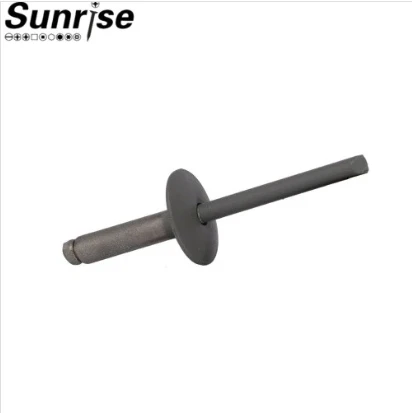
The working principle of the self clinching standoff nut is that through the action of the rivet head, the rivet is inserted into the nut and matched with the threaded parts to form a fixed part, which has the advantages of reliable fixing and convenient construction. At the same time, due to its small size, light weight, and convenient installation, it is widely used in industrial production processes.
How to Install Self Clinching Standoff Nut
Before installation, you need to confirm the location and quantity to be installed, and check whether the threaded holes are suitable. Matching rivets and nuts must be used to ensure they are suitable for the material and strength required of the connection. Pressure riveting nuts require the use of special riveting tools for installation, so appropriate tools need to be selected and prepared before installation. Use a special tool to fix the nut on the riveting tool head. Insert rivets into the rivet holes in the materials you want to join. Use a riveting tool to tighten the rivets in the joint cracks. During installation, press down with appropriate force until the riveting tool head is completely closed. When you hear a"click"sound, it means that the rivet has been fully pressed. Just remove the tool.
Our Factory
JiaXing Sunrise Import&Export Co,Ltd is a fastener supplier with a factory located in Jiashan, China. Our factory covers an area of over 10,000 square meters and is equipped with advanced machinery and equipment, enabling us to produce a wide range of high-quality fasteners. Our factory employs a team of experienced and skilled workers who are committed to producing only the best products.

FAQ
Hot Tags: self clinching standoff nut, China self clinching standoff nut manufacturers, suppliers, factory, Spherical Washer, Fibrocement Countersunk Screw, Steel Open End Blind Rivets, Stamping Sheet Metal, Butterfly Spring Washer, Stamping Steel Parts